

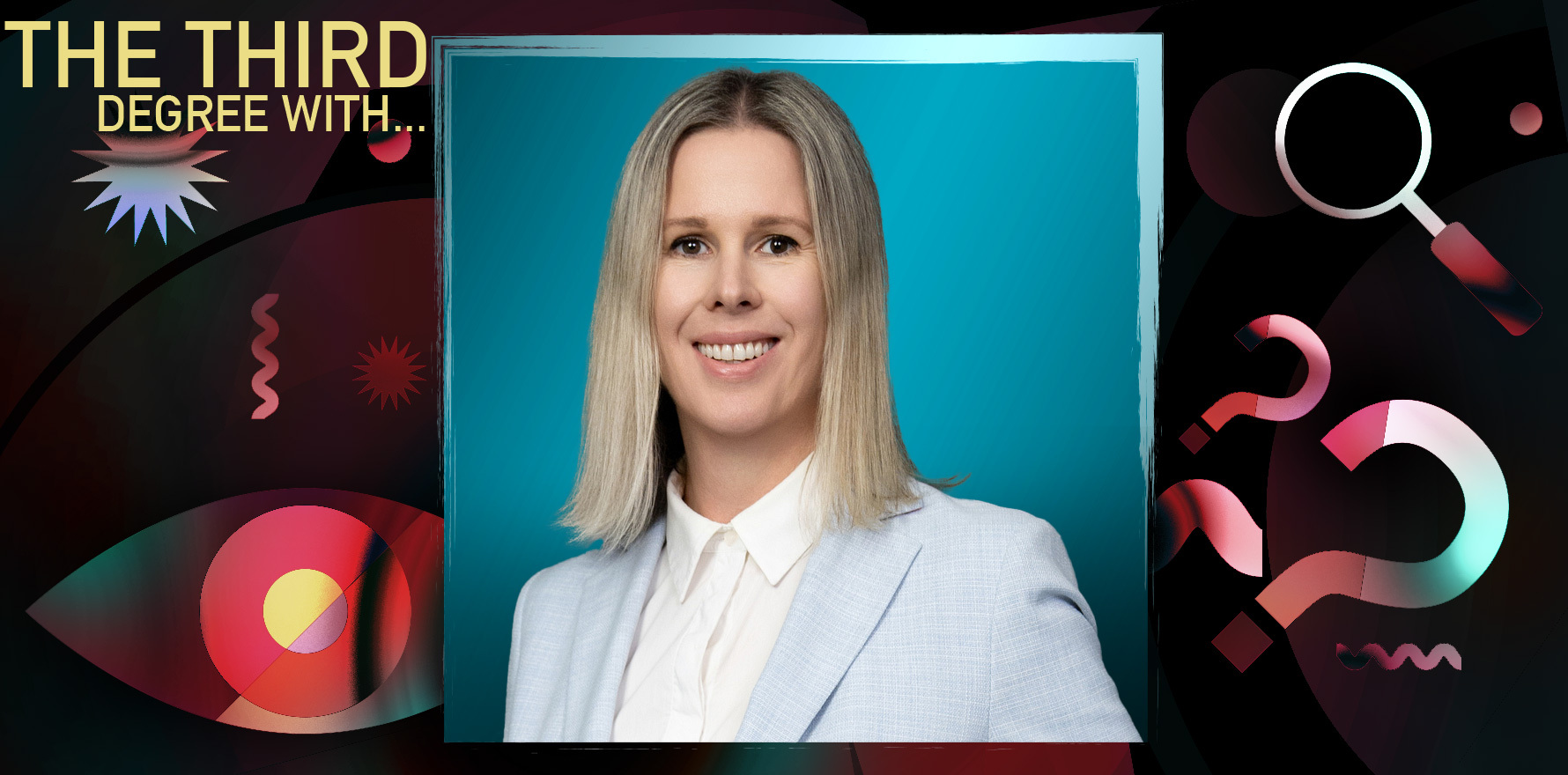
Newly minted Arthritis Australia CEO Louise Hardy shares her plans for the organisation, which has now entered its 75th year.
Generating renewed interest and investment in arthritis and musculoskeletal system research is one of Louise Hardy’s key goals as the newly appointed CEO of patient advocacy non-profit Arthritis Australia.
Ms Hardy, who has spent the last five months as interim CEO of the 75-year-old organisation, was officially appointed to the role in early February.
She’s been with the organisation in a policy and advocacy capacity since 2021, having previously worked at the Royal Australasian College of Physicians.
Rheumatology Republic sat down with Ms Hardy for a chat about her goals and vision for Arthritis Australia.
Rheumatology Republic: CEO is a bigger role than policy and advocacy. What will be some of the changes for you in taking on this role?
Louise Hardy: I’ve had a few years in the arthritis space, which is really valuable, so I’m not starting from scratch.
I’ve had time to develop some great relationships with the Australian Rheumatology Association, with rheumatologists and clinicians and researchers, and most importantly, I’ve been working with our consumers and our people with lived experience of arthritis, and really getting a deep understanding of the challenges that they’re facing.
We’re in our 75th year, so we’re obviously celebrating all that history and strong foundations, but we’re also really looking to how we have impact into the future, and particularly focusing around research funding is a key issue.
There has been long-term underfunding of arthritis and [Muskuloskeletal system (MSK)] research in Australia. We calculated that for every person with arthritis and MSK disease, there was $6 spent through the National Health and Medical Research Council in 2023. That compares to north of $100 for other disease groups. That’s very much a focus for advocacy, and we’re also looking at what we can do through our national research program to fund more innovative research that addresses consumer priorities.
RR: How did you end up in this space?
LH: I’ve actually got an arts degree, which might not be the most obvious background for this type of work, but I have worked in health policy for over 10 years both on the health professional organisation side and now the consumer side, so a pretty broad range of issues.
I think they’re both incredibly important perspectives. I really see my role as being that bridge between the lived experience and the incredible expertise that we have in Australia, through to the policy makers and the politicians, because they are often very busy people. They’re not going to be across the granular detail of all the issues in health, because it is such a crowded space.
What we see our role in Arthritis Australia as is making sure that we put the solutions in front of the policy makers and really raise their awareness of the challenges.
RR: You mentioned that arthritis is overlooked for research funding despite affecting a fairly high proportion of Australians. Why is that?
LH: Research funding has tended to focus more on higher mortality conditions – things that are going to kill people quickly.
There is, broadly, a poor awareness of the impacts of various types of arthritis and the fact that they can be life-limiting conditions, and particularly the impacts on productivity, and the fact that a lot of people may not be able to work, or may not be able to work as much as they would like.
RR: On that note – is it also partly down to the perception of arthritis as a disease which primarily affects the elderly? A friend in her mid-20s was recently told she likely has spondyloarthritis, and she was quite shocked.
LH: I think, in terms of community and political understanding, arthritis is trivialised.
It is seen as perhaps a normal part of ageing in many cases, and just something that happens as you get older.
Related



There is that real lack of appreciation that it can affect babies and toddlers. I think juvenile arthritis is about as common as juvenile diabetes, and absolutely affects younger people. The majority of people with arthritis are of working age.
I think that is one of the key messages that we try to get across in terms of raising awareness.
RR: One of the other areas I was curious about was the breadth and diversity of arthritis as a disease group, given that there are over 100 different forms. Does that affect advocacy efforts?
LH: That is one of the challenges, the sheer diversity of the types of conditions. Some of them are very rare, so there’s even more limited funding that goes into them.
Even though osteoarthritis is relatively common – I think there’s over two million people in Australia living with osteoarthritis – but there are still so many things that are poorly understood.
I think there are special sorts of challenges in arthritis research related to that diversity of conditions.
RR: On research and research investment, what type of research is it that we’re missing?
LH: [We would like to see investment toward] new treatments – things that will help people have better quality of life.
There’s obviously been incredible advances with the advent of biologics in particular, so there’s increased greatly improved outcomes for inflammatory arthritis and conditions like rheumatoid arthritis, but you still have people on lifelong medication, and some people go better than others.
There’s certainly some very exciting research happening in Australia. Professor Ranjeny Thomas, for example, has been funded through the Medical Research Future Fund to work on a vaccine that could effectively cure arthritis or rheumatoid arthritis in some people.
I think there is the potential for cures for some of these conditions within reach, and that would be an incredible advance for people who are currently on lifelong medication.
Osteoarthritis is also an area of great opportunity in regard to improving access and affordability of care.
The majority of Australians with arthritis aren’t receiving the care that clinical guidelines recommend.
We’re certainly advocating for the government to fund models of care that would not only improve the quality of life and the outcomes for those people living with osteoarthritis, but also lead to reduced rates of knee replacement surgeries and save the health system money as well. So that’s another key area.
I’d also like to mention our engagement with rheumatologists and with the Australian Rheumatology Association, which is really important. We have had a very strong and long-standing relationship with the Australian Rheumatology Association, and I’m really looking forward to continuing to strengthen that.
We greatly appreciate all the rheumatologists who contribute to our work in various ways, and we couldn’t do our work without their generous input. Everything from our scientific panel advising us on policy and other issues through to people joining our working groups to help us develop consumer resources.
I’m really looking forward to continuing that work with the rheumatology association and with rheumatologists, and also with our state and territory-based affiliate organisations who play that really key role on the ground, delivering programs in communities.
RR: We like to end these on a ‘fun’ question. What’s your go-to karaoke song?
LH: Elton John and Kiki Dee – Don’t Go Breaking My Heart. I like a duet – it’s nice to share the glory and the stage.
This article has been edited for length and clarity.
