

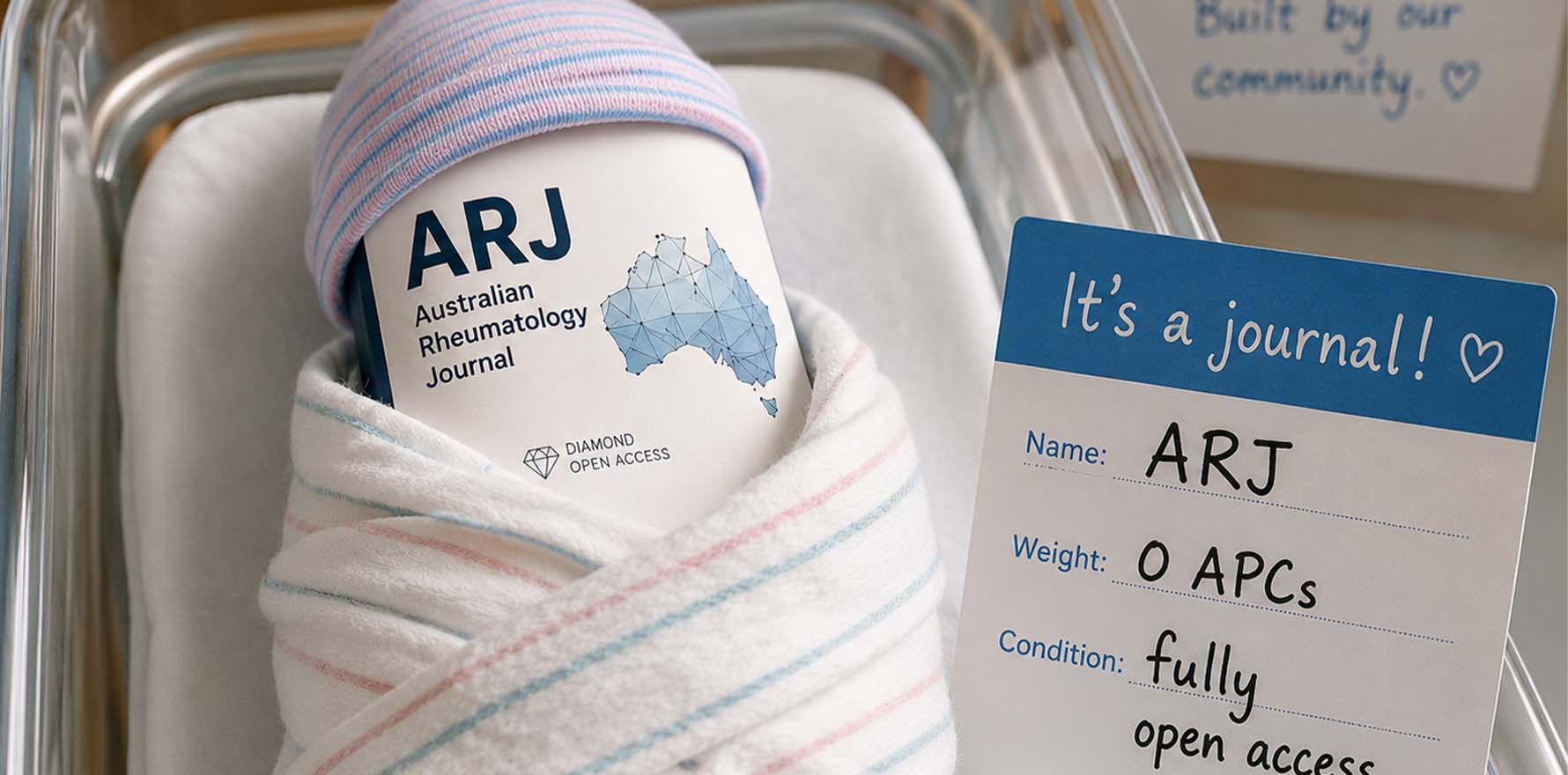
Founding editor Dr Sam Whittle says the new open-access publication aims to support Australian research and redefine rheumatology publishing in the AI era.
The Australian rheumatology community has formally launched the Australian Rheumatology Journal (ARJ), positioning the new publication as both a national research platform and a response to growing concerns about trust, commercialisation and artificial intelligence in medical publishing.
Launching the new journal at his last Australian Rheumatology Association ASM as president, founding editor Dr Sam Whittle described the initiative as an effort by the Australian rheumatology profession to reclaim ownership of scientific communication.
“In many ways, it seems like a kind of crazy time to launch a new journal,” Dr Whittle told delegates.
“There are journals everywhere at the moment. There’s a proliferation of medical publishing. We live in a world that’s now beset on all sides by artificial intelligence, and the medical publishing world is really in a state of flux.”
Despite this, Dr Whittle maintained that the upheaval in scientific publishing made this the ideal moment for professional societies to create independent, community-led journals.
“We think it’s actually the best time to embrace launching a new journal,” he said.
“We think that it’s the ideal time for professional societies and communities of practice to actually take control of medical publishing, free from commercial imperatives, so we can control our own publishing agenda.”
The vision outlined during the launch closely mirrored themes explored in the journal’s inaugural editorial penned by Dr Whittle, described the ARJ as an attempt to create a publishing model “more efficient, more equitable and more useful to authors and readers” in an era shaped by rapid biomedical growth and AI-generated content.
Central to the journal’s mission was the idea of provenance and trust. The editorial argued that in a publishing environment increasingly “distorted by commercial incentives” and saturated with synthetic content, professional society journals could provide something uniquely valuable: research curated and contextualised by clinicians and researchers working directly within the field.
“We wanted to be a beacon of trust,” Whittle told attendees. “The best thing that we can do as a professional society is to take back control of our publishing, so that our readers, all of you as a community can rest assured that the articles they’re reading in our journal have been selected, reviewed, published and contextualised by our own community of practice.”
The ARJ is intended to function as more than a conventional academic journal.
According to Dr Whittle’s editorial, the publication was designed to support the Australian Rheumatology Association’s broader goal of building “a complete Australian rheumatology ecosystem” that integrated clinical care, training, research funding, guideline development and knowledge translation.
Dr Whittle told ASM delegates the journal would combine international ambition with a distinctly Australian identity.
“We’ve got big ambitions for ARJ,” he said.
“We want it to be the world’s best rheumatology journal. We want it to be an outward-facing international journal of renown, but we want it to be very much centred in its own sense of place.
“We want it to be a truly Australian journal, so it will have a truly Australian flavour. We want it to reflect the issues that matter to Australian rheumatologists, to Australian rheumatology practitioners and to Australians who live with rheumatic diseases, including our Indigenous Australians and Australians who live in rural and remote areas, so we will have a very strong focus on those issues.
Another defining feature was the journal’s adoption of a “diamond open access” publishing model. Under this structure, all articles are freely available to readers worldwide, while Australian Rheumatology Association members are exempt from article processing charges.
“A diamond open access journal is one that is not only free to read, but for our members it’s free to publish,” Dr Whittle explained.
“There’ll be no article processing fees for ARA members, and every article that we publish will be free to read for everyone everywhere.”
The ARJ will operate as a fully digital, continuously published journal and plans to implement collaborative and open peer-review systems intended to improve transparency and engagement.
The editorial also signalled a deliberate departure from traditional publishing metrics. Rather than pursuing a conventional Impact Factor, the journal will prioritise community engagement, longitudinal influence and alternative measures of impact over what Dr Whittle described as “the metrics of an earlier era”.
Related



Education and workforce development were also expected to play a central role, he wrote. The journal plans to support trainee research publication, structured peer-review training and broader career development opportunities in academic publishing.
“An important part of nurturing a community of practice is to ensure that the next generation is inspired and supported to develop their own skills and create positive change,” Dr Whittle wrote.
“This applies not only to those who will carry on the rich tradition of world-class Australian rheumatology research, but more broadly to all of our trainees, who must become increasingly sophisticated consumers of research in the modern knowledge environment.
“To this end, teaching and training will be a key function of the journal from publication of trainee research projects to structured training and recognition of peer review, and opportunities for career development in academic publishing.”
Dr Whittle acknowledged the contribution of the editorial committee and ARJ staff, particularly Jacqueline Spedding, in bringing the publication to launch.
“We’ve been blessed to put together an incredible team,” he said. “It gives me great confidence that we’re going to put together a really great product for you all.”
The ARJ website is now live, with its inaugural editorial already published online. Whittle concluded by urging the rheumatology community to actively participate in shaping the journal’s future.
“We want you to join us on this journey,” he said. “We want you to read it, spread the news, send us your manuscripts, offer to be a reviewer for us and participate in building this together.”
“With that,” he concluded, “I would like to declare the Australian Rheumatology Journal open for business.”
