


A first-of-its-kind Australian study has explored how end-of-life care is delivered to patients with systemic sclerosis.
New Australian research has found end-of-life care in rheumatology patients is largely consistent with national standards.
Systemic sclerosis has the highest mortality rate among rheumatic diseases, with roughly half of all SSc patients dying from direct disease-related complications.
Despite this, international guidelines for the management of SSc do not cover the role of palliative care in these patients, and as a result little is known about the delivery of end-of-life care to people with SSc.
“In this study, we aimed to describe the provision of end-of-life care in SSc and assess the quality of care provided with reference to the National Consensus [Statement from the Australian Commission on Safety and Quality in Health Care,” a team of Australian researchers wrote in the Internal Medicine Journal.
“Second, we compared care between patients who died in a palliative care unit (PCU) and those who died in other hospital settings to explore the differences in care delivered between venues of care.”
The researchers retrospectively audited the medical records for all patients who died with SSc at St Vincent’s Hospital in Melbourne, Victoria, between 1 January 2013 and 31 December 2023. Data on patient demographics, SSc disease characteristics, and administered treatments were extracted and reviewed.
Thirty-three patients with SSc died during the study period, with the majority of these patients (n = 23, 70%) admitted via the emergency department. Most (n = 26, 79%) were female.
The most common subtype of SSc was diffuse cutaneous SSc (n = 18, 55%). The median age at death was 73 years, and the median SSc duration was 15 years. Fifteen patients had expected deaths in the palliative care unit, while a further 12 had expected deaths in non-palliative care settings such as the acute hospital or rehabilitation ward.
The provision of end-of-life care to patients with SSc largely followed the first four domains of end-of-life care outlined in the ACSQHC National Consensus statement, regardless of where in the hospital they died: (i) recognising that the patient is dying, (ii) using person- and family-centred communication and shared decision-making, (iii) using collaborative, multidisciplinary care, and (iv) providing comprehensive palliative care.
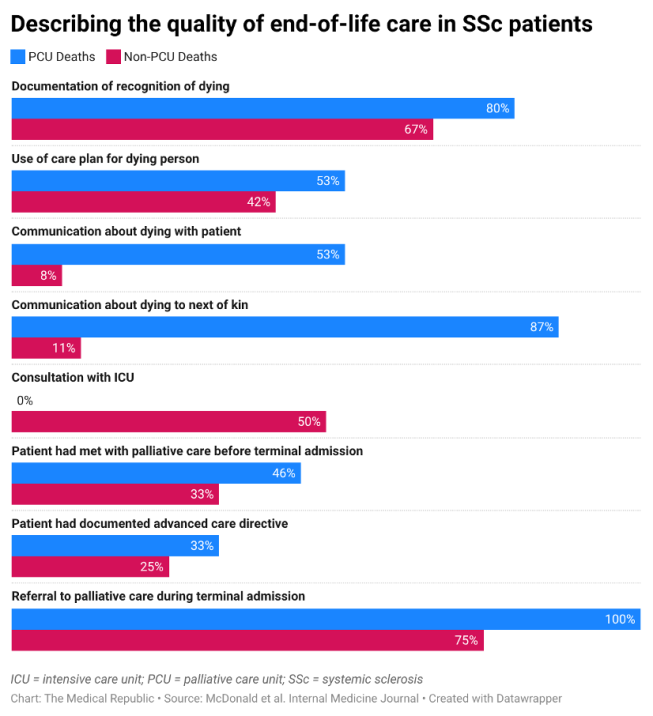
Several services were engaged to ensure a multidisciplinary approach was used in the delivery of end-of-life care to patients who experienced an expected death, including rheumatology (63%), cardiology (30%), psychiatry and general medicine (both 30%), and infectious diseases (22%). Most patients also had some level of allied health involvement in their end-of-life care, such as pastoral care (70%), social work (67%), and speech pathology (56%).
Symptom management was the most common reason for referral to palliative care for both PCU and non-PCU patients (93% and 58%, respectively).
Related



However, a (non-significantly) larger proportion of patients who died in the PCU were transitioned from active to comfort care in the final 48 hours of their life (80% versus 42%) and by the time of their death (80% versus 67%).
The audit showed potentially futile care and interventions were still performed within the final 48 hours of life, with blood tests, high-flow nasal prongs, and intravenous diuresis performed or provided in a handful of cases. Potentially inappropriate medications (e.g., vitamin D, chemotherapy, venous thromboembolism prophylaxis) were also administered in both PCU and non-PCU settings during this timeframe.
“To our knowledge, this study provides the first description of the quality of end-of-life care in SSc,” the researchers concluded.
“Overall, care at this tertiary SSc referral centre aligned with many elements of the Australian National Consensus Statement.
“These findings demonstrate that many core elements of high-quality end-of-life care can be achieved for people dying of SSc.”
The researchers felt that rheumatology and palliative care could be integrated into SSc management before a patient’s terminal admission, citing that rheumatology teams were “well placed” to raise the topic of advance care planning and serious illness conversations due to their long-standing relationships with patients and expertise about the likely course of disease.
“Earlier advance care planning may reduce the decision-making burden on families and clinicians during episodes of rapid deterioration and enable care that is aligned with patients’ values and preferences,” they wrote.
The researchers emphasised that their findings should be interpreted as them being critical of acute care teams, but rather that they highlight how challenging it is to care for patients with advanced SSc.
“The short median time between palliative care referral and death seen in this study, with some referrals occurring specifically for end-of-life care or within 24 hours of death, demonstrates the limited opportunity for specialist palliative care to meaningfully address symptom burden, facilitate advance care planning, or support patients and families,” they wrote.
“We advocate strongly that referral to palliative care should be guided by unmet palliative care needs rather than perceived short prognosis. Triggers for referral can include inadequately controlled symptoms, psychosocial distress, and decision-making support.”
Potential limitations of the study included its small sample size, single-centre location, and retrospective design.
